01
Hero identity
One perfect blade
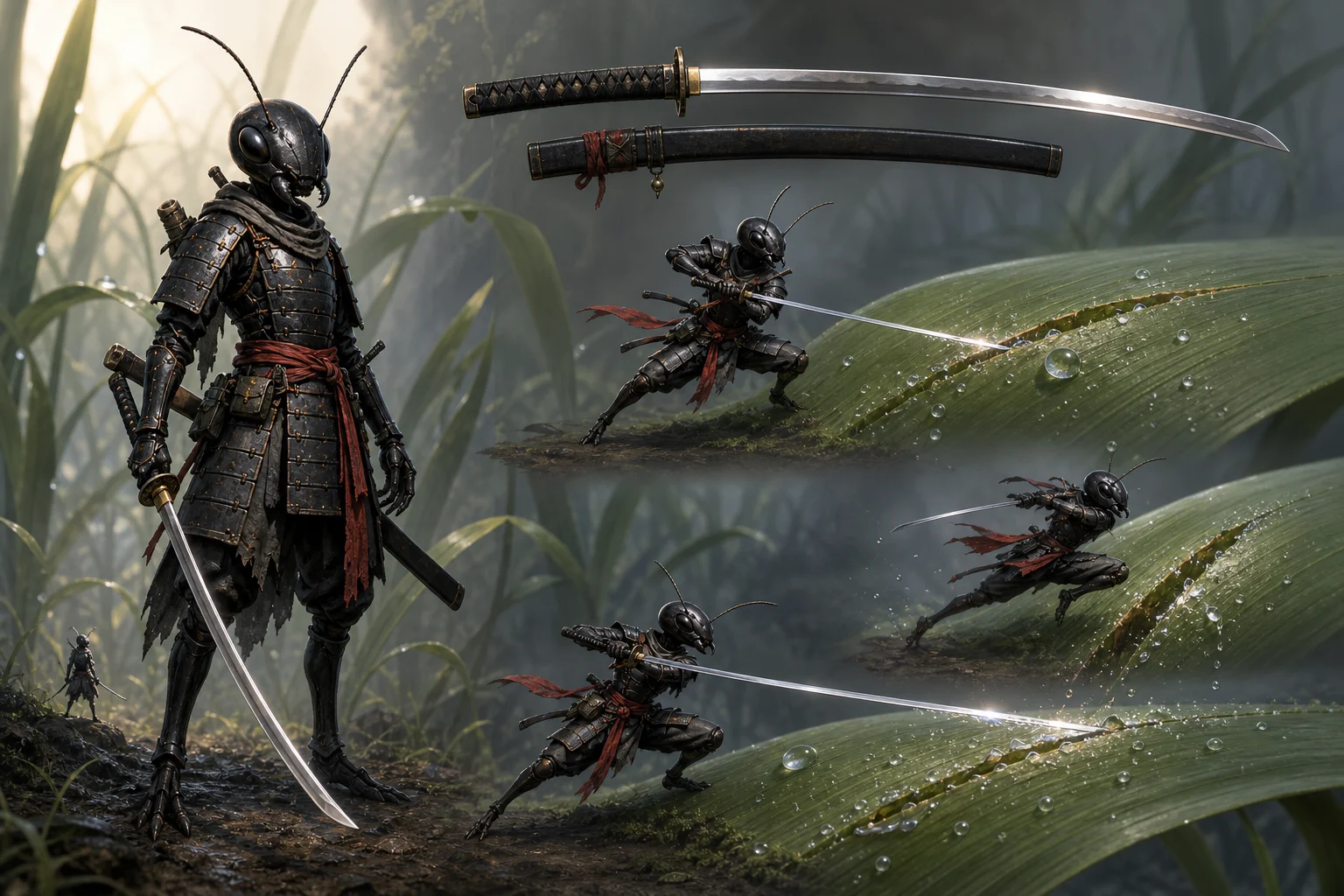
The slim ant samurai, immaculate katana and contact-accurate grass cutting. This board establishes scale, silhouette, dew and the quiet discipline of the world.
Visual direction archive
The generated concept images that defined Grasswake—collected in one place as the shared target for its world, hero, interface and progression.
Enter the archiveBegin with one perfect blade of grass. End with a civilization built from everything the blade taught you to master.
Grasswake is a material fantasy seen at ant scale: a slim samurai leaves a lived-in colony, learns the physical language of grass, bamboo, stone, water and roots, then brings those materials home. The katana is not only a weapon. It is the interface between player and world.
Curated reference set
These are generated direction images—not screenshots of the current prototype. Open any board to see it full-screen.
The images that established the ant-scale fantasy, the colony, the material journey and the possible endgame.
Hero identity
The slim ant samurai, immaculate katana and contact-accurate grass cutting. This board establishes scale, silhouette, dew and the quiet discipline of the world.
Home and cast
A warm root-and-resin settlement where harvest becomes visible growth. The Edgekeeper, Resinwright, Dew Seer and Weaver make every return feel consequential.
Garden encounters
Rescue routes, alternate paths and ecological bosses at ant height. Beetles are duelists; rats and birds are weather systems before they are enemies.
Material pilgrimage
A continuous journey through materials that demand different technique—not simply larger damage numbers. Each frontier teaches a new physical language.
Endgame fork
Grass tendons, bamboo spars, seed-shell cockpits and fitted stone. The coherent destination remains a forest-scale war, with human scale kept as a mythic possibility.
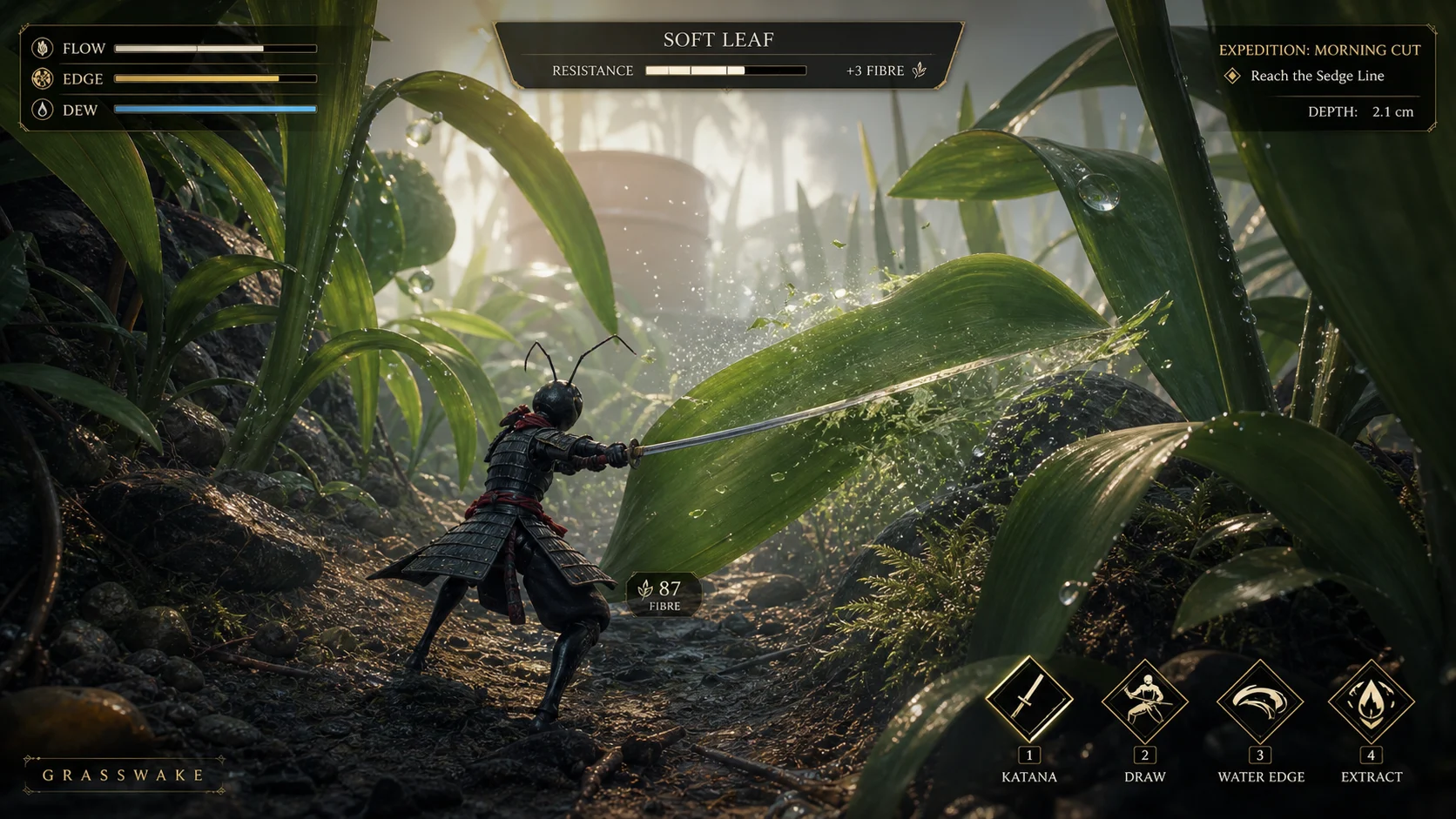
The closest expression of the actual game: camera, interface, wet materials, progression and blade-to-leaf contact.
Authoritative gameplay frame
Lacquered anime realism, monumental wet foliage, a low dynamic chase camera and a readable cut plane. This is the central visual target for the playable experience.
Modular progression
Ashen Vanguard grows through Fibre Greaves, Bamboo Servo Arms, a Dew-Stone Core and finally the Garden Warframe. Every upgrade is visible and cumulative.
Forge interface
A focused loadout screen with a real-time hero preview, body slots and meaningful comparison. Black lacquer, warm gold, ivory and jade form the interface language.
Return loop
The colony is the emotional payoff: gathered matter arrives physically, specialists awaken and three paths—blade, movement and material craft—open from the same hall.
Later-game proof
Partial mech legs and arms create a longer stride, airborne dash and wider cut without hiding the ant samurai. Progression is felt in movement before it is read in a stat.
Turnarounds for translating the chosen look into a real-time character, modular equipment and hero foliage.
Character turnaround
Front, side and back views lock the slim upright ant anatomy, lacquer plates, crimson silk and katana proportions for the first production-ready hero.
Equipment turnaround
Separate greaves, servo arms, core and warframe components retain their grass, bamboo, resin and dew-stone construction at every stage.
Foliage turnaround
Soft leaf, reed, fan leaf and bamboo forms shown with wet surfaces, vein structure and cut states. These are hero materials, not background decoration.
Production north star
“Keep the hero small enough that grass remains architecture.”
Perfect one interaction before multiplying content: the cut, deformation, fall, dew, sound, recovery and collection.